

The Middle Eastern Danse Macabre
by Irina Tsukerman


Riyadh’s Calculated Gamble: Saudi Arabia Tests a Narrow Corridor With Tehran
The succession of meetings that Mohammed bin Salman held with Pehezkian and the accompanying Iranian delegation was not a ceremonial reprise of past overtures. It was a stress test of a narrow corridor that Riyadh believes can exist between rivalry and limited accommodation. Saudi Arabia entered the talks with a disciplined checklist rooted in three imperatives. The first imperative was to quarantine active flashpoints so they do not contaminate Vision 2030 timelines or deter capital inflows. The second imperative was to impose a structure on Saudi-Iranian contact that survives personnel changes in Tehran and turbulence in Washington. The third imperative was to signal to global markets that Riyadh retains agency over regional risk regardless of great-power oscillations. Against that backdrop, each conversation with the visitors from Tehran served a distinct function and produced outcomes that, while provisional, added up to a coherent method rather than a one-off thaw.
The crown prince’s principal meeting with Pehezkian focused on the economic perimeter of the relationship. The Saudi side sought clarity on what Iran could realistically keep stable under mounting fiscal pressure at home and under tightening external constraints. Riyadh framed trade not as a reward but as a circuit breaker that reduces incentives for covert escalation. The practical ask was a narrow, bankable docket: facilitation for religious travel, resumption of limited commercial flights, pilot projects on medical supplies and pharmaceuticals that are less exposed to export controls, and a channel to discuss maritime insurance and port handling for non-sanctioned cargo. The Iranian side argued for a wider commercial opening and lobbied for oil coordination that would help Tehran monetize barrels without spooking OPEC+ discipline. The emerging outcome was modest but useful. Both sides agreed to constitute technical groups that would meet on a predetermined cadence to keep flight schedules, Hajj and Umrah logistics, and humanitarian trade moving even when the political weather turns foul. For Riyadh, the deliverable was not volume but predictability. For Tehran, it was proof of life for an economy that badly needs it.
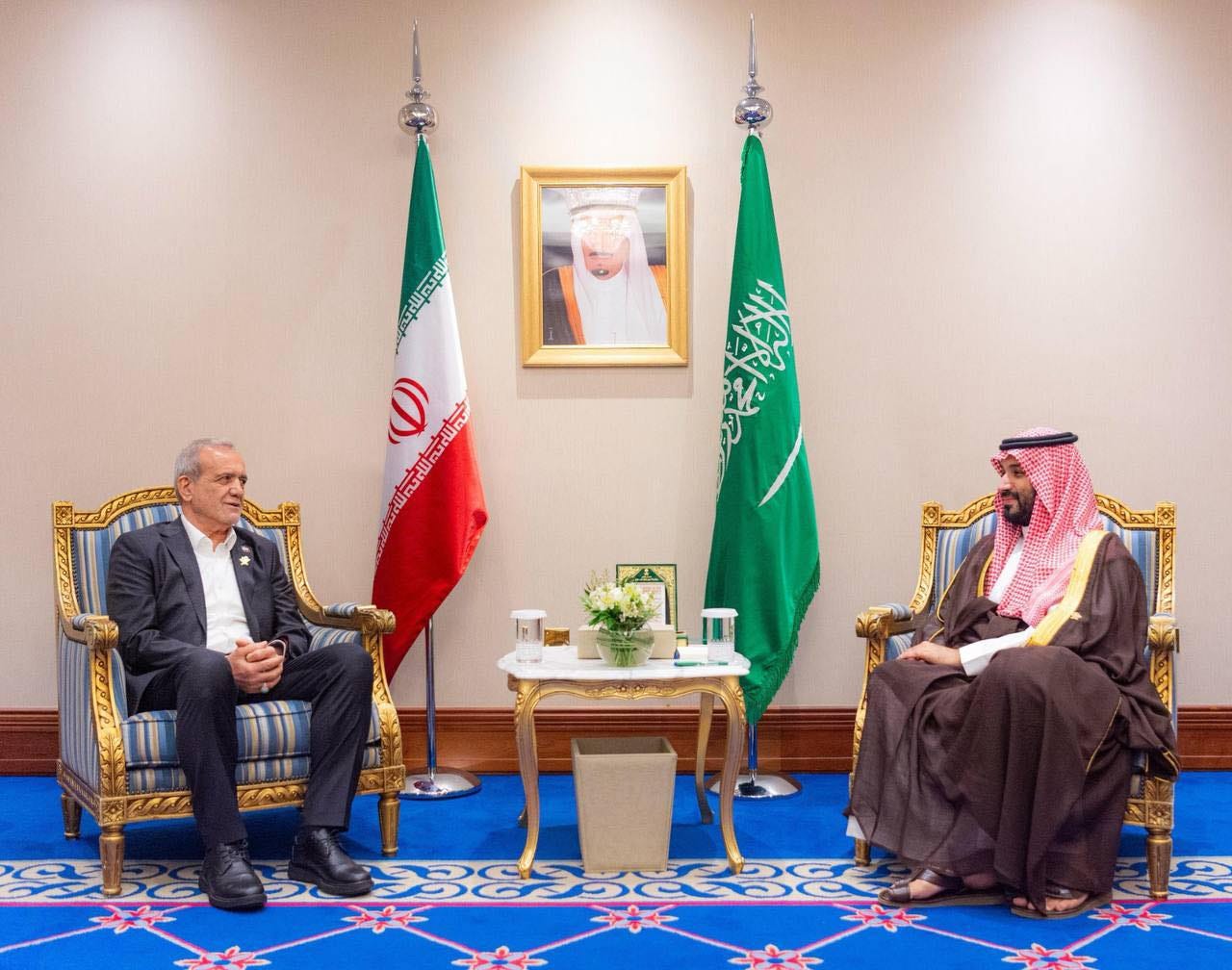
Iran’s President Masoud Pehezhkian and Saudi Crown Prince Mohammed bin Salman, meeting in Saudi Arabia, September 15, 2025 (Saudi Press Agency)
A separate session with Iranian security officials concentrated on rules of the road in the Gulf and the proxy map that links Yemen, Iraq, and the Levant. The Saudi delegation placed the Red Sea and Bab al-Mandeb at the center of the conversation because maritime risk premiums translate directly into insurance costs, freight delays, and investor anxiety. The discussion was deliberately unromantic. Riyadh did not ask Tehran to change its worldview. It asked for a measurable reduction in harassment of commercial shipping, a clearer hotline protocol for incidents that might involve Iranian-aligned groups, and a ceiling on the range, tempo, and public theatrics of missile and drone activity that could trigger miscalculation. The Iranian visitors did not concede authorship over any single actor but acknowledged that calibrated quiet benefits both sides. The immediate outcome was an understanding to stand up a discreet deconfliction mechanism between coast guard and port authorities, coupled with a commitment to exchange notice on naval exercises that might be misread in a tense environment. This did not eliminate risk. It transformed it from ambient and unpriced to episodic and managed.
A third track under the crown prince’s supervision addressed the Yemen theater. Riyadh’s position was concise. The Kingdom is prepared to let the political file in Sana’a move at a Yemen-first tempo if cross-border attacks remain dormant and if the Houthis’ external operations do not re-price Red Sea shipping. The Saudi side asked Tehran to use its influence to keep rocket and drone launches below a threshold that would force Riyadh into visible retaliation. The Iranian delegation, wary of appearing to command the Yemen file, nonetheless conveyed that escalation cycles could be dampened if there is a reliable flow of humanitarian fuel and if third-country facilitators do not attempt to starve Houthi-held areas of basic commodities. The tangible outcome was an implicit bargain. Riyadh would lean on partners to maintain humanitarian carve-outs and refrain from public humiliation campaigns while Tehran would encourage restraint that is legible to insurers and satellite trackers rather than simply asserted in communiqués. The bar for success was intentionally low. If six months pass without a sensational incident, the bargain will be judged to have paid for itself.
Religious affairs and consular services, while less dramatic, formed the fourth pillar of the engagements by the Crown Prince. The Saudi side insisted that the Hajj and Umrah files remain insulated from geopolitics and that pilgrim flows, security procedures, and consular dispute resolution be treated as technical routines with published timelines. The Iranian envoys pressed for expanded quotas and quicker resolution of detentions arising from documentation disputes. The near-term outcome was procedural. Joint liaison desks will operate seasonally with authority to approve case-by-case exceptions without escalating each incident to foreign ministries. For Riyadh, this was a test case for compartmentalization. If the most emotive sphere of interaction can be normalized, it strengthens the argument that other files can be structurally insulated as well.
Energy coordination was the quietest and most carefully phrased portion of the discussions. Saudi Arabia made no promises to underwrite Iranian export volumes or to defend any single producer’s market share. Instead, Riyadh restated a doctrine that stability in price bands serves all responsible producers and that surprise barrels introduced via opaque channels complicate that stability. The Iranian side asked, at a minimum, not to be targeted rhetorically at sensitive OPEC+ meetings and sought recognition that calibrated re-entries of Iranian crude could be sequenced without spooking buyers. The practical upshot was a rhythm of consultations on market conditions with an understanding that any public messaging would avoid zero-sum language. This is not a partnership. It is the codification of a vocabulary that reduces volatility.
The message embedded in the crown prince’s choreography was unambiguous for Washington. Riyadh demonstrated that it can grind down the edges of regional risk with or without a U.S. framework at hand. The choreography did not denigrate the American role, nor did it seek to replace it. It simply removed dependence on day-to-day mediation. For the United States, the signal was that a credible security partnership with Saudi Arabia now rests on complementarity rather than custodianship. If Washington brings air and missile defense architecture, technology transfer, and an aligned macro-energy strategy, Saudi Arabia will anchor that with its own neighborhood management. If Washington hesitates, Saudi Arabia will not let hesitation dictate its timelines. For the international community, especially energy importers and allocators of long-dated capital, the meetings said that the Kingdom operates with redundancy in its political risk management and that regional turbulence will not automatically detour its domestic transformation.
The texture of these outcomes cannot be understood without the backgrounder that looms over every Iranian conversation today, which is the onset of snapback sanctions implementation. Snapback is not an abstract legalism. It is a machine that reassembles the most consequential pieces of Iran’s economic isolation in weeks rather than years. Once activated, it narrows banking corridors, sharpens the bite of secondary sanctions on shippers, insurers, and commodity traders, and reanimates pressure on technology flows that matter for Iran’s aerospace, energy services, and dual-use supply chains. The immediate effect is to push Iranian commerce farther into barter, to expand the role of intermediaries in the Caucasus and the Gulf, and to strain Tehran’s budget math as discounts widen and collection cycles lengthen. The secondary effect is political. When easy oxygen disappears, Tehran’s leadership must decide whether to posture outward to rally a besieged public or to husband resources by dialing down the most expensive forms of adventurism.
Saudi Arabia reads snapback not as an invitation to gloat but as a forecasting tool. If the reimposed measures succeed in compressing Iran’s usable fiscal space, Tehran’s incentive to avoid catastrophic confrontation rises because reconstruction capital is unavailable and reserve buffers are thin. If, however, snapback triggers a nationalist reflex in which the regime substitutes external confrontation for internal legitimacy, then the near term becomes more brittle even if the medium term points toward exhaustion. Riyadh’s talks with Pehezkian were designed to pre-position the Kingdom for both trajectories. By building fenced economic channels that are humanitarian or religious in character, Saudi Arabia can maintain narrow, legitimate contact even as broader sanctions bite. By embedding deconfliction protocols at sea and on the Yemen frontier, it can lower the cost of responding to provocations without inviting an escalatory ladder that would draw in allies on unfavorable terms. And by keeping energy language disciplined, it can manage market psychology during a period when Iranian barrels may swing sharply in and out of visibility.
There is also the China dimension that snapback makes more salient. Beijing remains Iran’s critical outlet for crude and a patron for infrastructure, but it is also the most important growth market for Saudi petrochemicals, refining tie-ups, and downstream partnerships. As sanctions snap back, Chinese trading houses, insurers, and banks become more conservative even when headline volumes suggest business as usual. Riyadh’s calibrated engagement with Tehran communicates to Beijing that Saudi Arabia is a stabilizer that can keep shipping lanes open and prices predictable, while Iran is a volatility variable that can be dialed down if given narrow relief valves. The crown prince’s meetings thus doubled as a message to Asia’s big buyers. Supply from the Kingdom will not be held hostage to the political theater of the Gulf.
The domestic political economy of both countries intersects with this picture in ways that matter. Saudi Arabia is compressing multiple decades of diversification into a single decade. This requires flawless calendars for construction, tourism seasons that start on time, sports and entertainment schedules that are free of security scares, and financing plans that do not suddenly face repricing because of a missile incident. Iran is struggling to keep its grid stable, its currency from buckling, and its urban middle class from defecting psychologically. In that asymmetry lies the logic of the crown prince’s method. He will not outsource Saudi security to Iranian promises, but he will create small, verifiable regimes of behavior that reduce ambient danger and buy time for transformation at home. Tehran will not advertise dependence on Saudi goodwill, but it will bank any channel that lowers the cost of survival under snapback.
From this architecture of meetings and the snapback environment that frames them, three credible future paths present themselves. The first path is a limited partnership that grows out of the deliberately narrow channels now being constructed. In this path, the economic and consular working groups prove resilient, the maritime deconfliction desk matures into a routine exchange of notices, and Yemen remains quiet enough for relief operations to scale without producing headlines. Under continuing sanctions, Tehran prioritizes relief over theater and tacitly treats Saudi Arabia as a gatekeeper to a small set of legitimate outlets. The Kingdom does not lift Iran into prosperity, but it does prevent panic. Over time, energy consultations acquire more substance as both sides learn to talk about markets without triggering anxiety. This path does not end in trust. It ends in habit. Markets reward habit with lower risk premiums, and Vision 2030 projects benefit from a year or two of dullness along Saudi Arabia’s western maritime routes.
Inside a limited partnership, the tempo of provocations shifts from dramatic crescendos to background noise. Episodes still occur, but they are handled as process failures rather than existential insults. When a militia commander freelances an attack, the hotline works and the nearest actor with influence uses it. When a consular dispute arises during pilgrim season, the joint desk resolves it within hours. Within OPEC+ meetings, the lexicon of stability becomes familiar enough that traders learn to discount performative statements. The United States retains a premium role in hardware and intelligence integration for Saudi air and missile defense, while accepting that neighborhood management is owned by those who live there. China and India quietly approve because the cargoes they care about move on schedule.
The second path is controlled rivalry, which is the median scenario when ideology intrudes and snapback bites harder than Tehran can absorb without compensatory theatrics. In this path, Iranian-aligned groups probe at sea and along the Yemen perimeter with more frequency, and social media fills with images that force political reactions in both capitals. Riyadh’s deconfliction instruments function, but they are tested by clusters of small incidents that are designed to fatigue rather than to shock. The Kingdom responds with measured interception, visible but limited defensive operations, and calibrated public messaging that places responsibility on behavior rather than identity. Iran denies orchestration and claims reactive virtue even as the pattern is legible to analysts. The outcome is a more expensive equilibrium. Insurance rates for the Red Sea inch up, schedules add padding, and investors add a basis-point surcharge to account for nuisance risk.
Within controlled rivalry, the political theater in Tehran alternates between bravado and bargain signals, often in the same week. Snapback accelerates equipment shortages, so the cost of spectacular action rises. Yet the regime’s domestic narrative requires defiance. Riyadh’s counter-narrative emphasizes stewardship of the commons and protection of civilian shipping irrespective of flags. Both sides avoid actions that would pull in treaty commitments from allies. The Gulf becomes a chessboard where pawn trades are constant but queens never leave their files. The United States finds itself drawn into episodic shows of force to reassure shipping without dictating Saudi choices. Beijing tolerates the friction as long as receipts are met and as long as Saudi volumes and schedules remain the anchor of its import strategy.
The third path is relapse into hostility, triggered by a strategic shock that overwhelms the compartmentalization painstakingly built by the Saudi leadership. The shock could originate in a dramatic nuclear step by Iran, a misattributed mass-casualty incident at sea, or a domestic crisis in Tehran that produces a diversionary strike. Under this path, snapback acts as an accelerant rather than a dampener. Tehran calculates that only a display of audacity can reorder external expectations or consolidate internal cohesion. The Kingdom responds with a layered campaign of interdiction, targeted strikes, and public diplomacy that frames the confrontation as a defense of international commerce. The maritime deconfliction desk goes dark, consular liaison freezes, and energy consultations revert to monologues. The regional map hardens as partners take sides in visible ways.
In a relapse, the cost curve steepens quickly. Insurance becomes prohibitive for certain routes, alternative corridors take on new importance, and the Kingdom accelerates investment in redundancy for ports, pipelines, and air defense. The United States is drawn more tightly into Saudi defense, both by treaty logic with other partners and by the global economic implications of disrupted shipping. China recoils from exposure to Iranian risk and prioritizes the reliability of Saudi supply, even as it tries to broker restraint. Tehran’s fiscal position deteriorates faster than expected because the discount required to move barrels under confrontation consumes the margin left by sanctions workarounds. Domestic unrest grows. Under this path, the utility of the modest understandings achieved in the meetings with the Crown Prince is not that they survive but that they provide a template to rebuild contact once escalation burns itself out.
Across these paths, the animating principle of Saudi policy is not romantic reconciliation but rigorous compartmentalization. The crown prince’s meetings were designed to create small islands of order inside a rough sea. The snapback environment makes those islands more valuable because they are among the few legitimate places where limited interaction can occur without poisoning larger strategic equities. The message to Washington and to global markets is that Saudi Arabia will not let the region’s default setting of grievance dictate its growth calendar. The message to Tehran is that there are predictable returns to restraint and predictable costs to theater. If the next year proves kind, the narrow corridor will hold and routines will harden into norms. If it proves harsh, the Kingdom will fall back on redundancies and alliances that are prepared to absorb shocks without rewriting the arc of its economic transformation.
The immediate test will be whether the technical groups born of these meetings keep their schedules when headlines turn difficult. If they do, Riyadh will have demonstrated that it can manufacture continuity out of adversity and that it can extract practical value from a rival without importing the rival’s instability. That is the essence of the calculated gamble, and it is the only version of détente that the Kingdom can responsibly entertain at a time when sanction machinery is whirring back to life and when long-dated investments depend less on poetry and more on the punctuality of ships, planes, and cranes.
Iran at Doha: Integration or Instrumentalization?
Iran’s visible participation in the Doha-based Arab-Islamic Forum immediately raised questions about whether Tehran was on the path to genuine integration with its Arab neighbors or whether it was exploiting a stage of convenience to reinforce its narratives against the United States and Israel. To many observers in Tehran, the event was a symbolic victory: the optics of sitting alongside Arab leaders under the banner of Islamic unity created the appearance of legitimacy at a time when sanctions are tightening and internal pressures are mounting. Yet the deeper reading of the meetings reveals that Iran’s engagement was tactical, opportunistic, and more about narrative warfare than about reconciliation.
For Iran, the Doha Forum provided an opportunity to reposition itself not as an isolated, sanction-stricken state but as part of a collective Arab-Islamic bloc standing against Western domination and Israeli “aggression.” Iranian delegates emphasized the need for solidarity on Palestine, presenting Israel as the source of regional instability and portraying the United States as complicit in perpetuating occupation and war. This framing was not new, but its staging within an Arab-dominated platform allowed Tehran to amplify its message in a setting where anti-Israeli rhetoric has broad resonance. The message Iran sought to send was simple: despite sanctions and pressure, it remains an integral voice within the Islamic world, and its vision of resistance has allies.
However, equating participation with integration would be misleading. Arab states remain profoundly cautious about Tehran’s real intentions. True integration would require Iran to address Arab grievances over its interference in Syria, Iraq, Lebanon, and Yemen, and to take tangible steps to de-escalate tensions with Gulf states. None of that was on the table in Doha. Instead, Iran’s involvement resembled a hijacking of the agenda, channeling collective anger over Gaza into a platform for Tehran’s long-standing strategic objectives. In practice, Arab states tolerated its presence for optics and inclusivity but maintained deep reservations behind the scenes.
Qatar’s role as host was itself instructive. Doha has carved out a niche as a mediator and convener, and its willingness to host Tehran in the same forum as Arab leaders served both its image as a diplomatic broker and its interest in balancing between regional heavyweights. For Iran, this was a convenient arrangement: participation without accountability, exposure without concessions. For Arab states like Saudi Arabia, the UAE, and Egypt, the Forum was never going to be a mechanism to normalize Tehran, but rather a space where Iran could be corralled into rhetoric while its destabilizing actions remained excluded from serious security arrangements.
A core element of Iran’s strategy at Doha was indeed to isolate Israel diplomatically within the Arab world and to reframe the conflict as a test of sovereignty, justice, and independence. Iranian officials pushed the narrative that Israel’s actions in Gaza and its broader regional footprint were violations of Arab sovereignty, designed to dominate the Middle East under U.S. protection. This rhetorical maneuver was aimed not only at strengthening anti-Israeli sentiment but also at reversing the Abraham Accords momentum by pressuring Arab states that had moved toward normalization. By painting Israel as the aggressor and existential threat, Iran hoped to make normalization politically toxic and to shift the balance of discourse away from cooperation with Jerusalem toward confrontation.
Yet Tehran’s credibility in playing this role remains undermined by its own track record. Arab leaders are well aware of Iran’s long-standing use of militias and proxies, which have routinely violated the sovereignty of states such as Iraq, Syria, Lebanon, and Yemen. For Riyadh, Abu Dhabi, and Cairo, Iranian-backed militancy represents the same type of threat to sovereignty that Iran now accuses Israel of imposing. The contradiction between Tehran’s rhetoric of resistance and its actual practice of destabilization is not lost on Arab policymakers. Thus, while Iran may succeed in leveraging forums like Doha to inflame anti-Israeli sentiment in the short term, it is unlikely to translate this into lasting diplomatic isolation of Israel, particularly as Arab states pursue their own economic, security, and technological partnerships that run counter to Tehran’s agenda.
Saudi Arabia’s interpretation of Iran’s performance in Doha is layered and pragmatic. On one level, Riyadh views Iran’s attempt to monopolize the anti-Israeli discourse as a direct nuisance to its careful diplomatic balancing. The Kingdom has invested heavily in presenting itself as both a guardian of Palestinian rights and a pragmatic actor exploring normalization with Israel under conditions that serve its security and economic interests. Tehran’s loud performance at Doha threatened to corner Saudi Arabia into a more rigidly anti-Israeli posture than Riyadh prefers. Yet the Saudi government also recognizes the limits of Iran’s maneuver: Arab leaders may nod along with Tehran’s fiery rhetoric, but when it comes to tangible regional architecture, few are willing to entrust their futures to Iran. For Saudi Arabia, the Doha forum served as a reminder that Tehran can win applause but cannot win partners.
At the same time, Riyadh sees Iran’s exploitation of the Forum as an extension of the very opportunism it anticipated during its own bilateral meetings with Pehezkian. This is why the Saudi strategy has been to compartmentalize. Saudi Arabia understands that Iran will seize every multilateral platform to amplify its ideological message against the U.S. and Israel, but it also knows that this does not negate the transactional understandings on Yemen, maritime security, and consular affairs painstakingly crafted in bilateral settings. In other words, Iran’s grandstanding in Doha does not directly endanger the technical channels Saudi Arabia is building, though it does require Riyadh to double down on narrative management at home and abroad.
Moreover, the Doha episode must be seen in light of snapback sanctions reimposing isolationist pressures on Iran. As sanctions snap back, Tehran increasingly needs to offset the optics of renewed isolation. Participation in high-profile Arab-Islamic forums helps project an image of diplomatic vitality, of a state still capable of shaping regional discourse even under constraint. For Arab states, the risk of alienating publics by being seen as ignoring Israel or Palestine forces them to pay attention to what Iran says publicly — but it does not force them into acquiescence. For Saudi Arabia, particularly, Iran’s performance in Doha is a kind of narrative noise: it matters for public opinion and media but poses less risk to the practical, bilateral and security-based compartments that Riyadh is building.
As Washington’s interest in the region appears uneven — especially amid domestic political turbulence and pressing global crises — Arab capitals are feeling more freedom to shift gears toward Iran, but with caution. The relative disinterest by the U.S. administration in stronger Arab-Islamic pressure on Israel over Gaza, paired with rising tension between Arab populations and Israel’s policies, creates room for Arab governments to lean rhetorically toward Iran’s framing without fully committing strategically. For many Arab states, the cost of visible alignment with Iran remains high: disruptions to security cooperation with the U.S., possible economic retaliation, and domestic elite divisions that fear heightened sectarian framing. So far, most Arab states appear willing to shift their public rhetoric toward Iran’s narrative where it aligns with popular sentiment (especially regarding Gaza), but they are not prepared to shift the levers of their foreign policy architecture – defense, intelligence, trade – substantially toward Tehran.
Scenario Mapping: Iran’s Forum Diplomacy
Scenario 1: Incremental Normalization of Iran’s Presence
In this trajectory, Iran continues to appear at Arab-Islamic forums, using the Palestinian issue as the primary vehicle for acceptance. Over time, the mere repetition of Iranian participation reduces the stigma of engagement. Arab publics, already sympathetic to the Palestinian cause, create pressure on governments to tolerate Iran’s presence as part of a united front against Israel. Tehran exploits this to soften the optics of its isolation, creating space for limited bilateral contacts with sympathetic Arab states, such as Algeria or Tunisia, while deepening ties with Qatar and possibly Oman. In this scenario, Iran succeeds in weaving itself into the fabric of Arab-Islamic multilateralism, not as a trusted partner but as a tolerated fellow traveler. Saudi Arabia, in this version, faces more pressure to demonstrate consistency with Arab consensus rhetoric, making normalization with Israel harder to justify in the near term. However, Riyadh’s compartmentalized approach allows it to preserve bilateral channels with Iran while quietly maintaining dialogue with Washington and Jerusalem.
Scenario 2: Arab States Use Forums to Contain Iran
Here, Arab governments deliberately allow Iran’s participation in multilateral events but treat it as a pressure valve. By giving Tehran a platform for rhetoric, they deflect accusations of exclusion, but they keep the real work of regional integration — economic corridors, energy partnerships, security frameworks — firmly closed to Iranian influence. Iran is allowed to speak, but not to shape outcomes. Over time, this strategy exposes the gap between Tehran’s slogans and its inability to deliver material benefits. Israel, meanwhile, continues deepening quiet partnerships with Gulf states, which compartmentalize their rhetorical hostility at forums like Doha from their practical cooperation with Jerusalem and Washington. For Saudi Arabia, this scenario is the most advantageous: it allows the Kingdom to present itself as aligned with Arab-Islamic unity on Palestine while protecting its strategic autonomy in managing security partnerships. Riyadh positions itself as the bridge between public solidarity and private pragmatism.
Scenario 3: Rhetoric Escalates into Confrontation
In this path, Tehran doubles down on its use of forums like Doha to mount a full-scale narrative offensive, not only vilifying Israel but also attacking Arab states that have normalized or considered normalization. Iranian officials frame such governments as traitors to the Islamic cause, escalating tensions within the Arab League and creating visible splits. This risks backlash, as Arab states react defensively to Iran’s overreach. Instead of integrating, Tehran finds itself further isolated, while Israel quietly strengthens security and economic ties with those same Arab states under the shared umbrella of countering Iranian aggression. For Saudi Arabia, this scenario is both dangerous and clarifying. It forces Riyadh to protect its credibility as custodian of Islamic legitimacy against Iranian attempts to monopolize the Palestinian file, but it also allows the Kingdom to present Iran as the true destabilizer, undermining Arab cohesion. The result is sharper polarization, where Saudi Arabia doubles down on alliances with Washington and perhaps accelerates security cooperation with Israel under the table.
Across these scenarios, Iran’s strategy to isolate Israel within the Arab world faces severe limits. The Palestinian issue provides Tehran with fertile ground for rhetoric, but Arab governments calculate their interests pragmatically. The memory of Iranian-backed militias tearing at Arab sovereignty remains too fresh to allow Tehran to reinvent itself as a defender of sovereignty against Israel. At most, Iran may succeed in stalling normalization momentum, but it cannot erase the structural incentives that bind Arab states closer to Israel and the United States on security and technology. In this sense, Tehran’s participation in the Doha Forum is less about integration and more about opportunistic narrative warfare — effective in generating headlines, but insufficient to rewrite the deeper architecture of regional alliances.
Beyond the Optics: Reading the Pakistan–Saudi Defense Pact
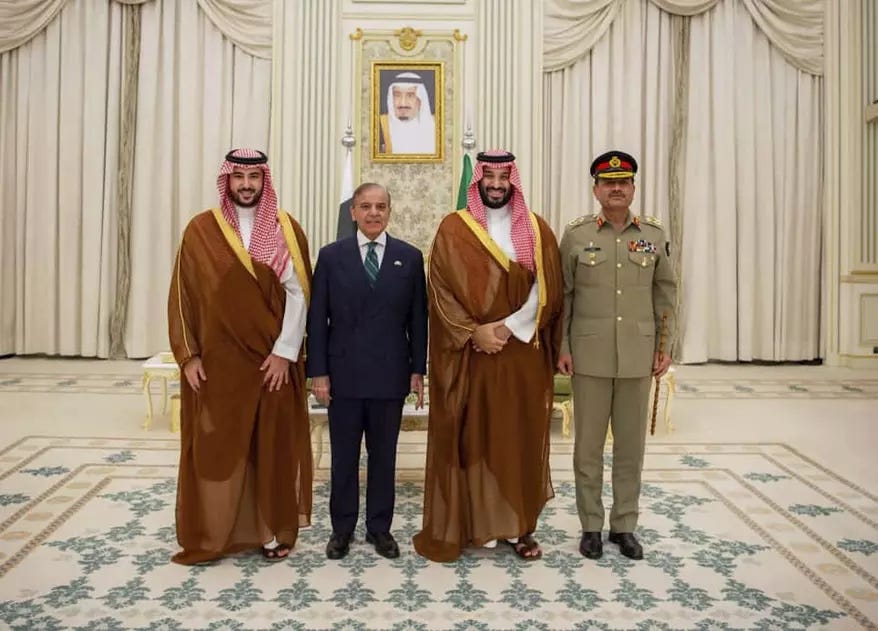
In this photo released by Pakistan’s Press Information Department, Saudi Arabia’s Crown Prince Mohammed bin Salman, second right, Saudi Arabia’s Defence Minister Khalid bin Salman, left, Pakistan’s Prime Minister Shehbaz Sharif, second left, and Pakistan’s Army Chief Field Marshal Asim Munir, pose for photographs after signing a mutual defense pact, in Riyadh, Saudi Arabia, Wednesday, Sept. 17, 2025. (Press Information Department via AP)
The Saudi–Iran dialogue and Iran’s opportunistic maneuvers in multilateral forums provide the backdrop against which the Saudi–Pakistani defense pact must be understood. After managing its complicated but necessary conversations with Tehran, and after witnessing Iran’s loud but ultimately hollow performance in Doha, Riyadh sought to anchor its security architecture in a more dependable lane. The pact with Islamabad is not just another bilateral arrangement; it is the Kingdom’s attempt to move from reactive, situational management of threats toward structural redundancy. It is the natural next step in Riyadh’s strategy of compartmentalization: maintaining channels with Iran, managing optics in Arab-Islamic platforms, but ensuring that the hard core of Saudi defense rests on stable, institutionalized partnerships with a trusted military power.
The new defense pact between Riyadh and Islamabad is less a surprise than a culmination, the moment when a dense web of training pipelines, quiet deployments, and emergency arrangements is elevated into a formal security architecture. The headline pledge—treating aggression against one as aggression against both—translates a long-standing habit of cooperation into treaty language that clarifies expectations for friends and rivals alike. Under that umbrella sit the practical lanes that matter in a crisis: joint planning for air and missile defense, standardized officer education, embedded trainers moving both ways, logistics that let units rotate quickly, and a preconfigured ability to surge Pakistani gendarmes and specialists to protect critical Saudi infrastructure. Formalization doesn’t merely ratify the past; it shields these practices from political weather and gives them legal durability when the region jolts. Just as important, it regularizes intelligence fusion on the kinds of threats that have become the new normal—missiles, drones, maritime harassment—and turns episodic exercises into a predictable calendar that builds muscle memory.
This dynamic, however, does not stop at the bilateral level. One possible trajectory is that the pact becomes the nucleus of a broader Sunni security bloc under Saudi leadership. If Riyadh uses its growing influence in the Arab world to pull Egypt, Jordan, and the Gulf monarchies into a defense structure anchored on Saudi wealth and Pakistani manpower, the regional balance of power would shift dramatically. Such a bloc would be the first genuinely Muslim-majority alternative to Western-led security guarantees, and its existence would deliver a profound message to both Tehran and Washington: that Riyadh can lead and coordinate Islamic defense without relying exclusively on external powers. But this scenario comes with risks. Iran would interpret it as an existential encirclement, sectarian polarization across the Middle East would deepen, and proxy conflicts would flare as Tehran seeks to undermine Saudi-led unity before it solidifies. The allure of leadership and prestige makes this outcome tempting for Riyadh, but it would be the most destabilizing.
The pact does carry a message for Washington, but not a break. Riyadh is stating, in treaty prose rather than rhetoric, that it will not leave gaps in its insurance policy to the vagaries of great-power attention. The United States remains the premium partner at the high end of the spectrum—air and missile defense integration, advanced sustainment, C4ISR—but the day-to-day resilience of the Gulf’s central energy hub now includes a second pillar that marries Saudi resources and basing with Pakistan’s large, war-seasoned military and export-ready defense industry. Islamabad, for its part, gains a dependable patron for its platforms and a counterweight when relations with Western capitals oscillate. The result is complementarity rather than substitution: America remains the strategic enabler; Pakistan becomes the nearer, faster-moving guarantor whose thresholds are easier to activate when minutes matter.
The balance between the U.S. and Pakistan fits most comfortably into the second scenario: the pact stabilizes as a bilateral insurance policy. Instead of expanding into a grand Sunni coalition, Riyadh and Islamabad quietly focus on making their military relationship predictable and durable. Exercises grow in scope, training pipelines expand, and intelligence cooperation becomes institutionalized, but without the political theater of bloc-building. For Saudi Arabia, this means redundancy without escalation; for Pakistan, steady revenues and influence without being dragged into sectarian conflicts. It is the path of quiet strength, the option most in line with Riyadh’s Vision 2030 priorities and Pakistan’s own need to avoid overextension.
Regional audiences will decode the pact through their own anxieties. For Arab governments unnerved by higher-tempo missile and drone incidents and by shipping disruptions, the notion that a broader, Muslim-majority “umbrella” might coalesce under Saudi leadership has domestic legitimacy that quiet cooperation with Israel often lacks. For Tehran, the symbolism is more sobering. A consolidated Sunni security lane now links Riyadh to a nuclear-armed state with expeditionary training experience and the manpower to augment Saudi protection during tense periods without declaring coalition warfare. Even if the pact is framed as defensive, it complicates calculations for harassment or deniable sabotage against Saudi energy nodes by raising the risk that a second, hard-to-deter opponent will be drawn in by design rather than improvisation.
And yet this very dynamic creates the conditions for the third, more dangerous scenario: provocation and escalation with Iran. Tehran could see the pact not as defensive insurance but as hostile encirclement. In response, it might activate proxy networks in Iraq, Syria, and Yemen more aggressively, seek to destabilize Pakistan’s western frontier through intelligence channels, and attempt to fracture the Saudi–Pakistani partnership by exploiting sectarian vulnerabilities inside Pakistan. Such escalation would force Riyadh to rely more heavily on the U.S. while leaning on Islamabad for rapid manpower and the implicit nuclear shadow. The outcome would be a more polarized Middle East, with sharper Sunni–Shia confrontation and greater risks of miscalculation spiraling into direct conflict.
The nuclear question inevitably hovers, and speculation about umbrellas and thresholds is part of the deterrence theater. Riyadh’s strategic preference has long been a robust conventional shield anchored in trusted partnerships, not a dash for its own warhead. Yet as Iran’s program advances and skepticism about external guarantees persists, the Kingdom has multiplied pathways that increase leverage without crossing red lines: a publicly codified lane with Pakistan that hints at extended deterrence, a parallel lane with Washington trading long-term alignment for advanced systems, and a disciplined energy diplomacy that dampens market panic during crises. In that triangulation, “access” functions as signaling power and bargaining chip, not as an operational plan—an assurance to domestic and foreign audiences that Saudi Arabia will not live under a permanent asymmetry. If the bilateral stabilization scenario dominates, nuclear ambiguity remains purely declaratory. But if escalation with Iran accelerates, the nuclear question would move from background deterrence into a central issue in Riyadh’s strategic calculus.
Understanding why this pact sits comfortably in both capitals requires the historical backdrop of Pakistan’s long balancing act between Saudi Arabia and Iran. Military and clerical ties with the Kingdom are deep, reinforced by decades of labor migration, financial support during lean periods, and repeated, low-visibility deployments of Pakistani troops for internal security and training roles. At the same time, geography, energy pragmatism, and Pakistan’s own sectarian equilibrium have compelled Islamabad to keep a serviceable channel to Tehran. The classic illustration of this fence-sitting came when Pakistan refused to join overt coalition warfare even as it voiced solidarity with Riyadh; the message was that manpower and training for defense were sustainable, while expeditionary campaigns against Iran’s allies were not. The new pact learns from that experience: it fortifies the lane that Pakistani politics and doctrine can actually support—defense of territory and regime-critical assets—while avoiding the optics of an anti-Iran crusade. Yet if the pact evolves into a full Sunni bloc, this delicate balancing act would collapse, forcing Pakistan into open confrontation with Iran, something its generals have historically avoided.
Labeling the agreement as a Sunni-bloc play, a hedge against American disinterest, or a move to outflank Iran each captures part of its logic, but none alone explains its durability. As bloc architecture, it offers a banner under which Arab militaries can work with Pakistan without making sectarian claims; as a hedge, it reduces response times and raises the price of attacks on Saudi infrastructure; as a competitive signal to Tehran, it warns that the cost of proxy audacity may be pooled, not borne by Riyadh alone. The versatility of the pact—defensive, legalistic, and operationally concrete—makes it domestically sellable in both countries and resilient to leadership churn. Which scenario dominates—bloc expansion, bilateral insurance, or escalation with Iran—depends on how Riyadh manages its dual imperatives of leadership and restraint, and on how Tehran chooses to interpret Saudi moves.
The domestic political puzzle piece is Pakistan itself, and here the pivotal actor is the army rather than any single civilian leader. That gives the pact a continuity that outlasts electoral cycles. The open variable is Imran Khan. There are visible external efforts to secure his release on humanitarian or procedural grounds, but his tenure strained Gulf investor confidence and complicated Saudi dealings that prize predictability. The most probable outcome is a controlled de-escalation: relief that lowers domestic temperature without restoring Khan to a cockpit from which he could unsettle the Saudi track. The security establishment will preserve the pact and its operational commitments regardless of who occupies the premiership, because those commitments map onto enduring institutional interests—funding streams, training pipelines, and an external partner that values Pakistan’s comparative advantages without asking it to fight the wrong war.
Pulled together, the agreement reads like sober architecture rather than spectacle. It converts years of practical intimacy into a shield that is explicit, legally robust, and tailored to the kinds of shocks that now define Gulf risk. It tells Tehran that mischief faces a taller staircase; it tells Washington that the Kingdom has redundancy without seeking a divorce; and it tells investors that a central energy producer has bolted its doors to a very large guard. If deterrence is partly about psychology, this is its quiet, institutional form—less a headline than a set of habits that make headlines less likely.
At a practical level, the deal reflects Saudi Arabia’s recognition that its grand transformation projects under Vision 2030 cannot proceed on schedule if security risks keep puncturing confidence. Pakistan, with its large pool of battle-tested manpower and relatively low-cost training infrastructure, is uniquely placed to plug those gaps. The Kingdom does not want to over-rely on expensive Western contractors for every niche role in internal security and protection of vital installations. Pakistani forces—already integrated into Saudi bases and familiar with the operating environment—offer Riyadh a scalable option that is politically palatable at home. The pact thus secures a steady pipeline of Pakistani trainers, technicians, and advisors who can expand the depth of Saudi defense institutions without the appearance of foreign dominance.
For Islamabad, the benefits are equally tangible. Saudi financial backing provides relief for a perpetually strained Pakistani economy, while defense-industrial exports find a reliable and solvent customer. Joint ventures and maintenance contracts tied to the pact will give Pakistan’s struggling defense industry new life and generate long-term revenue streams. Politically, Pakistan gains renewed relevance in Gulf security and a counterweight to Indian influence, especially as New Delhi has been deepening ties with the UAE and Saudi Arabia in energy and infrastructure. The pact allows Islamabad to signal that it remains indispensable to Gulf security, even as its Western alliances fluctuate.
The agreement also formalizes a division of labor that has existed informally for decades. Saudi Arabia brings wealth, advanced Western equipment, and a strategic position astride global energy lanes. Pakistan brings manpower, combat experience from decades of insurgency and conventional confrontation, and nuclear deterrence in the background. Together, they create a layered security architecture in which Saudi Arabia can claim leadership of the Sunni bloc without stretching its military beyond its current capacity, while Pakistan cements its role as a security guarantor without directly entering into wars of choice.
The triangulation with Iran is central to understanding the pact’s strategic messaging. Iran will inevitably view the agreement as an attempt to consolidate Sunni power against it, especially because it is concluded at a time when Tehran faces tightening sanctions, domestic unrest, and uncertainty over its nuclear program. Yet Pakistan is careful to frame the pact as defensive. It avoids overt commitments to expeditionary warfare or coalitions against Iran, keeping alive Islamabad’s long-standing practice of hedging. This ambiguity is deliberate: it allows Riyadh to suggest to Tehran that provocations will no longer go unanswered, while giving Islamabad space to reassure its own Shia population and preserve minimal working ties with its western neighbor.
The nuclear question, though never stated openly, forms the strategic shadow of the pact. Saudi Arabia has long hinted that, if pressed by Iran’s nuclear advances, it could turn to Pakistan for some form of nuclear assurance. Whether this means a declaratory umbrella, shared technology, or rapid acquisition has never been clarified. But the very existence of the pact reinforces the perception that such a pathway is politically feasible. In deterrence theory, perception often matters as much as reality. For Iran, the risk that any reckless move against Saudi territory might trigger a Pakistani response backed by nuclear capability increases the cost of escalation. For the United States, the pact underscores that, if Washington cannot provide long-term guarantees, Riyadh has other ways to level the strategic playing field.
Another dimension of the agreement is the potential for creating a Sunni security bloc under Saudi leadership. Over the past decade, various attempts to form Arab military coalitions have faltered due to divergent interests and lack of cohesion. With Pakistan onboard through a formal treaty, Saudi Arabia can present itself as the nucleus of a broader coalition that may, over time, attract other Arab partners. The framing as a purely defensive umbrella makes participation more politically acceptable for governments wary of being dragged into Saudi-Iran confrontations. This allows Riyadh to claim leadership of a pan-Sunni security framework without appearing sectarian, while simultaneously countering Iranian narratives of Shia solidarity.
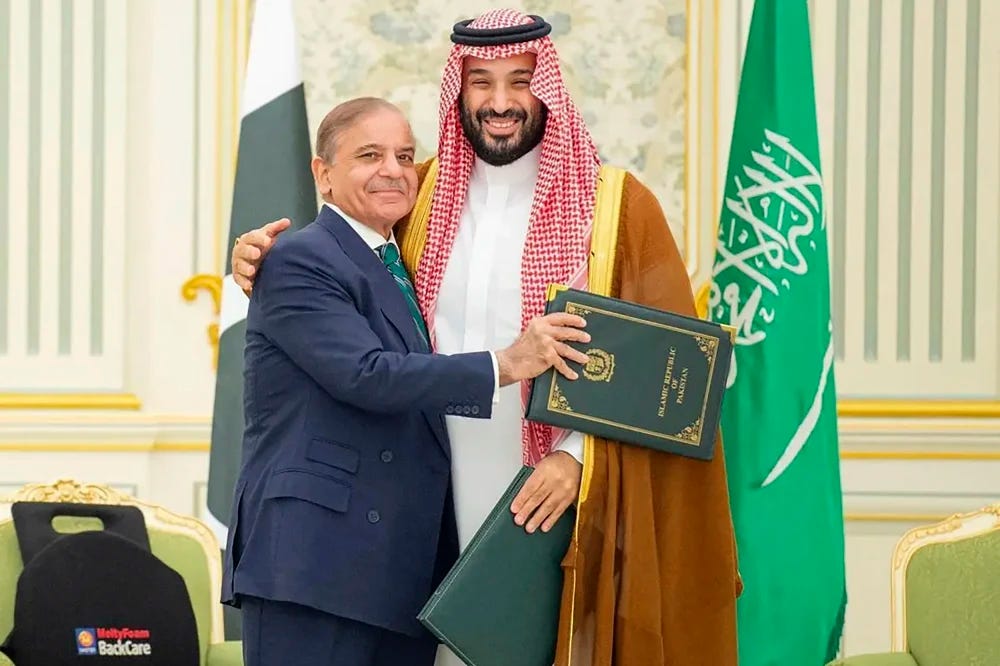
Pakistani Prime Minister Shehbaz Sharif with Saudi Arabia’s Crown Prince Mohammed bin Salman after signing a joint defense pact in Riyadh on Wednesday.Saudi Press Agency via AP
The pact also strengthens Riyadh’s hand in its parallel negotiations with Washington. By demonstrating that it can formalize robust defense ties with a nuclear power outside the Western orbit, Saudi Arabia subtly pressures the U.S. to remain engaged. The message is clear: American support remains valuable, but it is no longer exclusive. If Washington hesitates on arms sales, defense commitments, or political support, Riyadh has built-in redundancy. This does not mean that Saudi Arabia intends to replace the U.S. with Pakistan—American systems, training, and intelligence integration remain essential. But it does mean that Riyadh’s bargaining power increases, especially as U.S. domestic debates make sustained Middle Eastern commitments less certain.
From a domestic Saudi perspective, the pact is also about legitimacy. The Kingdom presents itself as the guardian of the Muslim world, and by allying formally with Pakistan—the only Muslim-majority nuclear power—it reinforces that claim. The agreement is thus not only about practical defense but also about symbolism: Saudi Arabia at the center of a global Sunni coalition that spans from the Gulf to South Asia. This narrative plays well domestically and regionally, reinforcing the Kingdom’s role as custodian of Islamic unity in contrast to Iran’s divisive militancy.
For Pakistan, the domestic balancing act is more delicate. While the military establishment welcomes the pact for strategic and financial reasons, civilian politics remains volatile. Imran Khan, who cultivated populist rhetoric that sometimes irritated Riyadh, remains a complicating factor. Trump’s efforts to push for Khan’s release reflect his personal rapport and political calculus, but Pakistan’s generals will ensure that any outcome does not threaten the Saudi relationship. A compromise is the most likely resolution—some relief for Khan that calms his supporters, without restoring him to a position where he could disrupt the Saudi track. For Riyadh, this outcome is satisfactory: stability in Pakistan, continuity in the defense pact, and reassurance that Islamabad’s commitments are institutional, not personal.
Ultimately, the pact is best understood as part of Saudi Arabia’s long-term strategy of redundancy and compartmentalization. In a volatile region where alliances shift and external powers hesitate, Riyadh is building multiple layers of insurance. The U.S. remains indispensable at the high end of the spectrum, Israel offers discreet but useful technology and intelligence cooperation, and Pakistan now provides manpower and the aura of nuclear backing. This multi-vector approach ensures that no single external partner can dictate Saudi Arabia’s security future. The defense pact is therefore not just a treaty; it is a structural statement that Saudi Arabia’s vulnerabilities are being progressively reduced, its options multiplied, and its leadership in the Sunni world reaffirmed.
Washington’s Reading: Between Alarm and Calculation
In Washington, the Saudi–Iran exchanges, the optics of Tehran’s participation in Doha, and the formalization of the Saudi–Pakistani defense pact are being read through multiple, often competing lenses. Policymakers and analysts see a convergence of trends that signal both opportunity and danger: Saudi Arabia is diversifying its security portfolio, Iran is experimenting with new avenues of influence, and regional actors are openly maneuvering around the ambiguities of American commitment. The Biden administration’s disinterest has already left a vacuum, but under Trump’s second term, Washington is trying to recalibrate without conceding ground. The question is whether this recalibration will restore American primacy in Gulf security or merely acknowledge that the Kingdom now operates in a multipolar framework.
Inside the White House, the Saudi–Iran meetings are viewed with a mix of skepticism and cautious approval. Skepticism arises from the belief that Tehran is buying time, using dialogues with Riyadh to ease its isolation while continuing to fund militias and advance its nuclear program. Approval, however, comes from the possibility that direct Saudi–Iran channels reduce the immediate risk of an oil shock or military escalation in the Gulf, outcomes that would complicate U.S. global strategy. Trump, ever pragmatic in this sphere, is less concerned with whether Iran acts in bad faith than with whether Saudi Arabia can manage its own security without forcing Washington into costly interventions. His calculation is that a Saudi Arabia capable of compartmentalizing dialogue with Iran while simultaneously strengthening defense ties with Pakistan and the U.S. is a Saudi Arabia that reduces the burden on American forces. If Riyadh can do both successfully, Washington benefits indirectly, and the outcome resembles a scenario in which U.S. primacy is reasserted: America remains the indispensable backstop, but Saudi diversification makes the region more manageable, and Trump can claim burden-sharing without conceding influence.
Now that the defense and civilian agreements discussed during Trump’s visit have been concluded, however, another question is quietly shaping internal White House deliberations: is Saudi Arabia slipping onto the back burner of U.S. foreign policy priorities? With Trump having secured the optics of deals that can be presented domestically as victories—expanded defense cooperation, arms sales, and the promise of future investment flows—there is a risk that Riyadh becomes less central in day-to-day policymaking. Attention in the Oval Office often shifts quickly to where Trump sees the most immediate political benefit, whether in negotiations with Beijing, confrontations with Tehran, or campaign-stage gestures toward Israel. In this context, Saudi Arabia risks being treated as a success already banked, a partner reassured enough to require less political energy. For Riyadh, this possibility is double-edged: while it frees the Kingdom from constant American micromanagement, it also means that the White House could prioritize other theaters, forcing Saudi leaders to ensure their concerns remain visible in Washington’s crowded agenda.
From this vantage point, one possible trajectory emerges clearly: a scenario in which the United States reasserts its primacy in the Gulf. In this pathway, Trump seizes on Saudi diversification not as a threat but as leverage. He accelerates negotiations for a formalized U.S.–Saudi defense treaty, expands arms sales, and integrates Riyadh more deeply into U.S.-led regional command structures. By providing the Kingdom with advanced missile defense systems, cyber capabilities, and renewed assurances of deterrence, Washington re-establishes itself as the irreplaceable guarantor. Saudi hedging through Pakistan is tolerated but carefully bounded, folded into a wider U.S.-backed coalition that locks Riyadh into American frameworks. The result is a recalibrated but stronger U.S. role, with Trump presenting burden-sharing as proof of leadership rather than retreat. In this scenario, Riyadh avoids the back burner by becoming the showcase partner in Trump’s broader Middle East policy. The Kingdom’s centrality is reinforced, not diminished, because Washington needs visible Gulf successes to prove that American primacy remains intact.
Already, specific policy steps have been announced that reinforce this possibility. The State Department has reinterpreted export restrictions under the Missile Technology Control Regime, making advanced drones like the MQ-9 available to Saudi Arabia under looser conditions. A $3.5 billion sale of advanced air-to-air missiles and upgrades for Saudi F-15s has been cleared, strengthening Riyadh’s deterrence capability with American technology. Parallel to this, U.S. officials have indicated that a pathway toward a civilian nuclear cooperation agreement is being reopened, offering the prospect of a “123 agreement” under strict safeguards if Saudi Arabia accepts conditions on enrichment and reprocessing. Trump has also touted the $142 billion defense deal announced during his Gulf tour as the “largest in history,” paired with hundreds of billions in promised Saudi investment and expanded cooperation on minerals, space, and science. These steps not only signal U.S. willingness to keep Riyadh supplied with cutting-edge capabilities but also anchor Saudi Arabia in a framework that makes a true back burner outcome less likely—at least so long as these deals remain politically useful for the White House. Within the White House, these same steps are now the litmus test for whether Saudi Arabia stays front-of-mind: if drone export implementation moves quickly, if the AIM-120C package flows on schedule, if a concrete 123 draft reaches Capitol Hill, and if the big defense/investment package keeps generating domestic “wins,” Riyadh remains a daily priority; if not, the back-burner drift accelerates.
At the Pentagon, the Saudi–Pakistani pact is dissected in detail. On the one hand, it raises concerns about nuclear ambiguity and the precedent of U.S. allies turning to other nuclear powers for security assurances. On the other, defense officials recognize that Pakistan’s role as a rapid-reaction partner may reduce immediate Saudi demands on U.S. assets in the event of a drone or missile campaign by Iran or its proxies. If Riyadh can rely on Islamabad for manpower, training, and conventional deterrence, Washington’s own commitments can be concentrated on higher-end systems and strategic deterrence. The pact, in other words, could serve U.S. interests by stabilizing Saudi security from below, even if it complicates Washington’s monopoly on security guarantees in the Gulf. Pentagon planners also note that if Saudi Arabia keeps this lane strictly bilateral, Washington gets the best of both worlds: reduced operational strain without losing central control. That calculus is reinforced by the concrete policy moves: the MTCR reinterpretation and the cleared AIM-120C sale keep Saudi combat-credible inside a U.S. sustainment ecosystem, while any future air-defense or C4ISR add-ons ensure interoperability remains American-led. For the Pentagon, converting those approvals into signed LOAs, delivery timelines, and end-use monitoring is what turns “managed diversification” from a talking point into muscle.
This institutional view at the Pentagon points to the managed diversification scenario. Here, Riyadh multiplies its options, but Washington remains firmly in control of the upper tier of capabilities. Saudi Arabia leans on Pakistan for manpower and redundancy, but the U.S. retains exclusivity over missile defense, advanced aircraft, cyber capabilities, and intelligence integration. From Washington’s perspective, this scenario allows the U.S. to offload some operational burden while maintaining irreplaceable primacy. For Riyadh, it provides resilience: if one lane falters, another remains open. Managed diversification becomes a stable, if untidy, equilibrium in which Saudi Arabia is never left hostage to one partner, but the U.S. still sits at the center of the web. Yet in this outcome, the back burner issue becomes more visible: Saudi Arabia remains operationally indispensable to Pentagon planners but risks losing the constant high-level visibility in the White House. The Kingdom’s importance is guaranteed in the defense bureaucracy, but its day-to-day political salience may diminish unless it continually renews its relevance at the presidential level. The reopened “123” pathway fits here as governance spine: if talks advance, State and DoE lock Saudi civilian nuclear ambitions into U.S. rules while DoD continues to anchor the high end of deterrence—precisely the blend that stabilizes hedging without ceding primacy.
At the State Department, there is sharper discomfort with the optics. The image of Saudi Arabia building alternative alliances, deepening ties with Pakistan, and engaging Tehran in diplomacy sends the signal that Washington is no longer the indispensable convener of Gulf stability. Diplomats fear that this will erode U.S. leverage not only in Riyadh but across the Gulf, where smaller states may follow Saudi Arabia’s lead in diversifying their partnerships. For career officials, this raises the specter of a region increasingly oriented around Saudi-led initiatives in which Washington is a partner of choice, not of necessity. Trump’s political team, however, reads the same optics differently: as proof that U.S. allies are taking responsibility for their own defense in ways consistent with his long-standing demands. What unnerves State is what reassures Trump’s inner circle: that U.S. primacy is being reshaped into something less absolute but still strategically decisive. State points to the drone reinterpretation and the mammoth arms/investment package as double-edged: they keep Riyadh tethered to U.S. frameworks, but once the headlines fade, the optics of Saudi autonomy return unless the 123 track produces verifiable safeguards that only Washington can credibly enforce. That’s where back-burner risk meets optics—without visible progress on governance, diversification looks like distance.
Yet here lies the risk of the waning leverage scenario. If Washington mismanages the transition—either by punishing Saudi diversification too harshly or by neglecting to renew its commitments—Riyadh could accelerate its independence. It could lean more heavily on Pakistan and, eventually, China for nuclear and defense cooperation, while using direct talks with Iran to demonstrate that it no longer relies on U.S. mediation. In such a pathway, Washington does not orchestrate diversification; it is forced to watch as its influence shrinks to crisis response while Riyadh builds a multipolar order on its own terms. In this scenario, Saudi Arabia does end up on the back burner in the White House. Having already banked the major agreements, Trump may turn his attention elsewhere, leaving Riyadh to secure its own position through new alignments. The back burner becomes not just a possibility but the very definition of waning leverage: Washington is still there, but Riyadh no longer depends on its attention. Practically, this is what it looks like if MTCR-based drone deliveries are delayed, missile packages languish under congressional holds, and the 123 pathway stalls—Riyadh reads that as drift and speeds up alternative lanes.
Congress, meanwhile, is split. Hawks view the Saudi–Pakistani pact and Riyadh’s flirtation with Tehran as warning signs that U.S. influence is waning, and argue for tightening the screws on Iran while offering the Kingdom new incentives to keep it anchored firmly in the American orbit. Skeptics of U.S. engagement, by contrast, see in these moves evidence that the Gulf can police itself, allowing Washington to devote more attention to the Indo-Pacific and to great-power competition with China. The divide reflects the broader tension in U.S. strategy: whether to double down on traditional partnerships in the Middle East or to let the region’s actors balance one another while America limits its exposure. In practice, the choice Congress makes could tilt the balance between the reassertion and waning scenarios: push for deeper engagement, and Washington remains at the center; push for retrenchment, and Riyadh takes matters further into its own hands. In both cases, the back burner issue reappears: a more activist Congress could force Trump to keep Riyadh high on the agenda, but a skeptical Congress could allow the Kingdom to fade further from daily attention. The concrete fights here are obvious: notifications and oversight on drone exports, timelines and end-use monitoring for the AIM-120C/F-15 package, and any submission of a 123 agreement to the Hill. How those are handled will either hard-wire reassertion or push the system toward waning leverage.
In the intelligence community, the consensus is that Iran is playing a sophisticated double game—using forums like Doha to project integration and cooperation, while continuing to entrench militias and asymmetric assets across the Levant and the Gulf. Analysts caution that Saudi Arabia is not naïve about this, but is hedging: drawing Iran into diplomacy to blunt short-term risks while erecting new deterrence structures through Pakistan and, ultimately, through a recalibrated partnership with Washington. The likely trajectory, in this view, is not Saudi drift away from the U.S., but Saudi multiplication of options so that no single partner can hold its security hostage. This is precisely what defines managed diversification—Riyadh gains redundancy, Washington retains primacy at the high end, and Tehran is kept guessing about the balance of alignments. In this reading, the back burner question matters less: Riyadh’s relevance is secured by the intelligence flows that keep Washington tethered to Saudi decision-making. Even if political attention drifts, operational necessity prevents Riyadh from ever being truly sidelined. For the IC, the test will be whether new drone deliveries and missile upgrades come with robust EUM and ISR integration that deepen reliance on U.S. networks; if they do, political drift won’t sever operational centrality.
The unresolved question of nuclear energy runs through all these scenarios. The U.S.–Saudi civilian nuclear energy deal that Trump touted during his first visit to the Kingdom was supposed to cement Washington’s centrality by offering Riyadh modern reactors under American safeguards while ensuring that enrichment would remain outside Saudi control. But that agreement has languished, slowed by U.S. bureaucratic caution, congressional skepticism, and shifting Saudi priorities. Riyadh has not abandoned its nuclear ambitions, but it has broadened its options—turning to Russia, China, and South Korea for reactor contracts, and now to Pakistan as a strategic hedge. The defense pact with Islamabad does not replace the civilian nuclear track, but it does alter the balance: instead of relying on Washington to deliver nuclear cooperation, Riyadh can now hint at Pakistan as an alternative pathway, even if only at the level of deterrent ambiguity. For Washington, this is both a warning and a pressure point—if it fails to revive the nuclear energy deal, Riyadh may deepen its quiet nuclear signaling through Pakistan, feeding suspicions that defense cooperation masks latent proliferation potential. Inside the policy process, “pathway” language on a 123 is the fulcrum: table draft text and verification terms, and reassertion/managed diversification stay viable; let it drift, and waning leverage gathers speed.
Israel reads this development with unease. Jerusalem interprets the stalling of the U.S.–Saudi civilian nuclear deal not only as a missed opportunity to bind Riyadh firmly to American safeguards, but as an opening for alternative nuclear partnerships outside Western oversight. The defense pact with Pakistan, in Israel’s eyes, sharpens this danger: it does not immediately mean proliferation, but it provides Saudi Arabia with plausible deniability while keeping open the possibility of Pakistani nuclear know-how becoming relevant in a crisis. For Israel, the nightmare scenario is a Riyadh that leverages its defense pact to pressure Washington into concessions while retaining Pakistan as a shadow option. This possibility strengthens Israeli arguments inside Washington for tightening oversight of both the civilian and defense tracks, to ensure that Saudi hedging does not evolve into an undeclared nuclear umbrella. Israeli interlocutors can live with drone and missile upgrades if EUM is ironclad; their red line is a 123 that leaves enrichment ambiguity. That’s where they will press hardest to keep Saudi off any path that weakens U.S. leverage.
India, for its part, views the same developments through a regional security lens. New Delhi has long balanced its close ties with Riyadh against its hostility with Islamabad, but a formal Saudi–Pakistani defense pact adds layers of complexity. The failure of the U.S.–Saudi civilian nuclear deal and the potential for Riyadh to lean on Pakistan heightens Indian concerns that Islamabad could parlay its nuclear status into greater prestige and leverage in the Gulf. For India, this risks altering the balance of influence in South Asia, as Saudi Arabia’s partnership with Pakistan could embolden Islamabad diplomatically and strategically. It also complicates New Delhi’s own energy security planning, as India has relied on strong ties with Riyadh to shield itself from the fallout of Pakistan’s instability. New Delhi will watch U.S. drone and missile transfers for signals about Saudi preferences; but the prestige impact it fears most would come from an inert U.S. nuclear track that leaves Pakistan looking like Riyadh’s only nuclear-adjacent option.
For Riyadh, these parallel concerns in Israel and India are not accidents but leverage. By leaving the U.S. nuclear energy deal in limbo while cultivating defense cooperation with Pakistan, Saudi Arabia increases pressure on Washington from multiple directions. Israel demands tighter safeguards, India worries about Pakistani prestige, and both lobby Washington to prevent Saudi Arabia from drifting too far outside the American framework. Riyadh, in effect, turns the very ambiguity of its nuclear pathway into a bargaining chip: either Washington revives the civilian nuclear deal on favorable terms, or Saudi Arabia continues to expand its options, hinting at partnerships that unsettle U.S. allies. This tactic keeps Saudi Arabia at the center of strategic debate in Washington, ensuring that no American administration can afford to ignore its security demands—even if day-to-day attention in the Oval Office shifts elsewhere. And because those debates hinge on tangible files—drone deliveries, missile timelines, and 123 text—Riyadh can keep pulling Washington back from the back burner by forcing decisions on concrete items rather than abstractions.
Looking forward, Washington is likely to respond in several ways. First, Trump will push to finalize long-discussed U.S.–Saudi defense agreements, tying deeper military integration to energy cooperation and the Kingdom’s investment flows into the American economy. This is meant both to reassure Riyadh and to signal to domestic critics that the U.S. is securing tangible returns for its commitments. Second, Washington will quietly pressure Pakistan to limit any overt nuclear signaling, ensuring that Saudi–Pakistani cooperation does not trigger alarms in Israel or India. Third, the U.S. will recalibrate its messaging on Iran: maintaining the sanctions snapback, reinforcing deterrence with visible deployments in the Gulf, but allowing Saudi–Iran dialogue to proceed as a stabilizing complement. Fourth, Trump is expected to use Riyadh’s diversification as leverage to push for normalization with Israel, arguing that U.S. guarantees remain indispensable for managing the triangular pressures of Tehran, Islamabad, and Jerusalem. Operationally, expect the administration to translate the MTCR reinterpretation into signed LOAs and deliveries, keep the AIM-120C schedule on track with strict EUM, and—if reassertion or managed diversification are truly the aim—table actual 123 language. Those follow-throughs are what keep Riyadh off the back burner.
In practical terms, the most likely outcome is a hybrid. Washington will neither resist Saudi diversification nor wholly endorse it. Instead, it will seek to anchor Riyadh firmly within the U.S. orbit by upgrading cooperation in intelligence, cyber defense, and advanced weapons, while tolerating Saudi initiatives with Pakistan as a useful, if sometimes uncomfortable, redundancy. The message from Trump’s Washington will be simple: Saudi Arabia can explore other lanes, but America remains the central lane—and the one that unlocks global legitimacy, advanced deterrence, and economic rewards. Should Washington handle this balance deftly, the result will look like managed diversification: Saudi Arabia hedges, but U.S. primacy remains intact. If handled poorly, however, the United States could find itself sliding into waning leverage, a scenario where Riyadh uses its growing ties with Pakistan and Iran as bargaining chips rather than commitments, leaving Washington less indispensable than it has ever been. And if Washington doubles down successfully, the reassertion scenario still lies within reach, preserving the American role not only as guarantor but as the architect of the region’s future security order. In each scenario, the “back burner” issue becomes a measure of success or failure: in reassertion, Riyadh dominates the White House agenda; in managed diversification, it risks losing presidential attention but remains operationally vital; in waning leverage, it becomes a sidelined partner forced to make its own way.
The Elusive Peak: Hopes, Demands, and the Trump Factor
As the dust settles on the recent flurry of exchanges, visits, and agreements, the central question is what it would take for U.S.–Saudi relations to return to the level of strategic intimacy they enjoyed at their height, when the Kingdom was Washington’s most reliable Arab partner and America was the undisputed guarantor of Gulf security. Both sides have their wish lists, and both are aware that the political climate has changed so radically that even a perfect alignment of interests may not restore the golden age. Still, the aspirations and frustrations on each side reveal the contours of the partnership and the obstacles that stand in its way.
For Riyadh, the primary demand is clarity. The Kingdom wants unambiguous assurances that Washington remains committed to its security—not just through arms sales and intelligence cooperation, but through formalized, treaty-level commitments that make U.S. protection binding rather than discretionary. This reflects Riyadh’s deep unease about American reliability, particularly in light of shifting U.S. priorities and the perception that Washington’s focus on China and domestic politics leaves the Gulf as a secondary concern. A peak relationship, in the Saudi view, would mean more than transactional deals; it would mean codified guarantees, comparable in spirit to U.S. commitments to NATO or key Asian allies. In exchange, Riyadh is prepared to expand its role as a stabilizer, continuing to open investment channels, cooperating on counterterrorism, and—even if quietly—supporting U.S. efforts to contain Iran.
Yet the Saudis also expect Washington to respect their diversification of partners. Peak relations in Riyadh’s view would not preclude defense cooperation with Pakistan, economic projects with China, or tactical dialogues with Iran. Instead, the Kingdom seeks recognition that its multipolar posture is not a betrayal but an insurance policy. For Saudi leaders, genuine partnership with Washington would mean space to maneuver, not exclusivity. They want America to acknowledge this new reality without resorting to punitive measures or moral lectures. If Washington can accept Saudi diversification as part of the price of partnership, Riyadh is ready to deepen military cooperation and invest heavily in the U.S. economy.
From Washington’s perspective, peak relations look somewhat different. The Trump White House is less concerned with treaty-level commitments than with visibility and loyalty. What Trump wants most is for Saudi Arabia to showcase its alignment with U.S. goals—whether through normalization with Israel, increased investment in U.S. projects, or public demonstrations that Riyadh still treats Washington as its primary partner. Trump is transactional: he sees peak relations not as a matter of formal treaties but as a string of high-profile wins that he can present to his domestic audience. If Saudi Arabia delivers on those optics—multi-billion-dollar deals, symbolic gestures toward Israel, headline-making investments—Trump will proclaim the alliance revitalized. For the administration, the measure of success is political theater as much as strategic substance.
The divergence between Riyadh’s structural demands and Washington’s transactional preferences is what makes peak relations so elusive. Riyadh sees the absence of treaty guarantees as evidence that America cannot be fully trusted, while Washington sees Saudi hedging as proof that the Kingdom is not fully committed. This mutual suspicion creates a cycle of disappointment: Riyadh fears abandonment, Washington resents perceived disloyalty. Peak relations would require breaking that cycle through a dramatic gesture, such as Washington offering treaty-like assurances or Riyadh publicly normalizing ties with Israel. Both moves are conceivable but fraught with political cost, making them unlikely without extraordinary circumstances.

Iran looms large in this calculus. For Saudi Arabia, the ultimate test of American reliability is whether Washington will stand firm against Iranian adventurism. If Trump were to make visible moves—reinforcing sanctions, backing Israeli strikes, or deploying naval assets to counter Iranian threats—Riyadh would see that as a concrete step toward peak relations. Conversely, if Trump flirts with partial accommodation of Tehran to ease U.S. tensions in the Gulf, the Saudis will interpret that as proof that America’s commitment is conditional, further justifying diversification. Iran thus serves as both a gauge and a wedge: a gauge of U.S. seriousness, and a wedge that drives Riyadh to seek guarantees elsewhere when Washington hesitates.
Israel, too, is a decisive factor. Trump has consistently sought to make Saudi–Israeli normalization the crown jewel of his Middle East diplomacy. For Washington, nothing would symbolize peak relations more strongly than Riyadh agreeing to openly formalize ties with Jerusalem, thereby locking itself into the U.S.-Israeli security umbrella. Yet for Riyadh, this step is a bargaining chip, not an inevitability. The Kingdom wants to extract maximum guarantees from Washington before making such a leap. If Trump cannot provide treaty-like assurances or a clear pathway to a civilian nuclear agreement under U.S. safeguards, Saudi leaders are unlikely to burn political capital on normalization. Israel thus becomes the litmus test of alignment: Washington demands it as proof of loyalty, Riyadh withholds it as leverage.
Pakistan complicates the equation further. The new Saudi–Pakistani defense pact provides Riyadh with a hedge that dilutes Washington’s monopoly on the Kingdom’s security. For Saudi Arabia, this partnership signals to Washington that Riyadh has other options, including a nuclear-adjacent one. For the U.S., it raises the specter of Saudi Arabia drifting too close to a nuclear threshold outside Western control. Peak relations, in this context, would require Riyadh to demonstrate restraint with Islamabad—keeping defense cooperation conventional and transparent—while Washington revives the long-stalled civilian nuclear energy deal to prove that American safeguards remain the only viable path to a nuclear future. Without that balance, the Pakistani hedge will remain a permanent source of mistrust, making peak relations structurally impossible.
This is where the Trump factor becomes decisive. For all his willingness to strike grand deals, Trump is notoriously mercurial. Allies find him unpredictable, prone to abrupt shifts, and quick to recalibrate based on domestic optics. For Saudi Arabia, this unreliability is precisely why diversification has become non-negotiable. No matter how many agreements are signed, Riyadh doubts that Trump would risk American forces to defend Saudi territory in the event of a crisis with Iran. That skepticism undercuts any hope of returning to the unquestioned reliance of the past. In Saudi eyes, peak relations require certainty, and Trump offers anything but.
Three possible futures stem from this tension. In one scenario, Riyadh gambles on Trump’s pragmatism and pursues normalization with Israel, betting that such a dramatic gesture will lock in Washington’s commitment and produce the formal guarantees it craves. This would represent the closest thing to a restored peak, but it requires political courage in Riyadh and credible follow-through in Washington, neither of which is assured. In a second scenario, relations plateau in a state of managed pragmatism: Trump secures investment and optics, Saudi Arabia secures weapons and partial assurances, but both sides accept that the relationship is functional rather than transcendent. This managed equilibrium prevents collapse but falls short of the golden age. In the third scenario, frustrations mount—Riyadh concludes that Trump’s unreliability cannot be overcome, while Washington interprets Saudi hedging as betrayal. In this case, the relationship enters a long decline, not broken outright but stripped of the trust and intimacy that once defined it. Iran’s militias, Israel’s demands, and Pakistan’s nuclear ambiguity will each amplify this drift, ensuring that no bilateral gesture alone can reverse it.
These scenarios highlight a paradox: both sides would like to see a return to peak relations, but neither is willing—or perhaps able—to make the concessions required. Riyadh cannot surrender its multipolar posture, and Washington under Trump cannot provide ironclad guarantees. The most realistic outcome, therefore, is a middle ground where both sides extract what they need—Saudi Arabia gains weapons and economic deals, Washington gains optics and influence—but neither achieves the absolute confidence that once bound them. Peak relations remain an aspiration, recalled nostalgically but unlikely to be reborn in the current political climate.
Ultimately, the fate of U.S.–Saudi relations under Trump will be determined not by shared interests, which remain substantial, but by perceptions of reliability. As long as Riyadh doubts that Washington will honor its commitments, and as long as Washington doubts that Riyadh will resist hedging, the relationship will operate below its peak. Trump’s unpredictability ensures that neither side can fully relax, and the golden age remains a memory rather than a blueprint. Yet the fact that both sides still articulate visions of peak relations—however divergent—underscores the enduring importance of the partnership. It may never return to its zenith, but it will also never fade into irrelevance.
This is one of the most comprehensive, forensically detailed geopolitical analyses I've encountered in years. The throughline connecting Saudi Arabia's 'compartmentalization' strategy - maintaining narrow technical channels with Iran while building structural redundancy through Pakistan - reveals a level of strategic sophistication that most Western analysts completely miss. Your point about snapback sanctions functioning not just as isolation but as a 'forecasting tool' that compresses Iran's fiscal space is exactly right: it's not about punishment, it's about reshaping Tehran's incentive structure toward restraint rather than theater. The three-path scenario mapping (limited partnership / controlled rivalry / relapse into hostility) is brilliant because it shows how the same set of initial conditions can produce radically different outcomes depending on how snapback bites and whether Tehran chooses to absorb pressure or externalize it. What strikes me most is your observation that Riyadh's meetings with Pehezkian were designed to 'create small islands of order inside a rough sea' - that's the essence of resilience in a multipolar world. The Pakistan dimension is particularly sharp: you correctly identify the pact as neither pure insurance nor Sunni-bloc architecture, but as 'versatile' - defensive, legalistic, operationally concrete, and resistant to leadership churn. The nuclear ambiguity you describe ('access as signaling power, not operational plan') is textbook deterrence theory applied brilliantly to Gulf dynamics. Washington's dilemma - reassertion vs. managed diversification vs. waning leverage - captures the Biden/Trump transition perfectly: Trump wants optics and transactional wins, Riyadh wants treaty-level commitments, and the gap between those preferences is what makes peak relations 'elusive.' The detail about the MTCR reinterpretation for MQ-9 drones and the $3.5B AIM-120C sale shows you're tracking concrete policy moves, not just abstractions. Your observation that 'the most realistic outcome is a middle ground where both sides extract what they need but neither achieves absolute confidence' is probably the best single-sentence summary of U.S.-Saudi relations I've seen. And the Iran-at-Doha section nails it: Tehran is 'hijacking the agenda, channeling collective anger over Gaza into a platform for its long-standing strategic objectives' - participation without accountability, exposure without concessions. The scenario where Arab states 'use forums to contain Iran' by giving Tehran rhetoric but keeping real integration closed is exactly what's happening. The throughline connecting critical minerals (China's rare earth dominance) to this geopolitical choreography is what makes this essential reading for anyone tracking resource geopolitics. This should be required material for think tanks, but it's too sophisticated for most of them - they're still stuck in the 'Iran good/bad' binary while you're mapping three-dimensional strategic possibilities. The sourcing density alone is staggering. Absolutely essentil work.